Co-producing better access to women’s health in the Black Country
On average, women in the UK live longer than men, but they also spend a significantly greater proportion of their lives in ill health and disability.
The UK government’s first Women’s Health Strategy was released in 2022, which sets out to improve how the health and care system listens to women’s voices and boost health outcomes for women and girls.
More focus needs to be placed on women-specific health issues, more representation is needed in important clinical trials, and more knowledge is needed in both a professional and public capacity to ensure a better understanding of conditions that affect women and conditions that affect both men and women in different ways.
In response to the national strategy, and to help us make the best decisions locally, we wanted to have the opportunity to hear and learn from women across our local communities, to understand the experiences behind the statistics and develop a collective voice and narrative for sustainable change.
To better understand the experiences of local women, we partnered with 12 voluntary, community, faith and social enterprises (VCFSE) from underrepresented communities to help co-design solutions that address local women’s health priorities through collaboration, lived experience and creativity. These organisations included Changing Lives, Cranstoun, THIA CIC, European Welfare Association, Bread for Life, JAC Healthcare, SLAM! Basketball, The Way Youth Zone, Steppingstones into the Community, Beacon Centre, Sandwell Visually Impaired and Breakthru CIC.
Each organisation was commissioned to hold open conversations with women in their local areas, exploring barriers and stigmas that may prevent them from having good access to women’s health services.
After an initial briefing, the organisations were given a month to carry out the conversations in ways that worked best for their communities. The Black Country Integrated Care Board (ICB) did not attend or direct the sessions, to ensure each organisation had full autonomy and a safe space where participants could speak freely and discuss health matters they might not have otherwise shared. This approach led to the engagement of over 1200 women and girls.
We then hosted a series of five workshops to discover, define, develop and deliver solutions based on the insights we’d heard.
Our conversations revealed a powerful mix of experiences, barriers and opportunities for change. The findings highlight where support, education and system improvements are most needed to create more equitable women’s health outcomes in six key areas:
1. Gaps in knowledge and education
2. Barriers to accessing services
3. Feeling dismissed by healthcare
4. Menstrual health inequalities
5. Cultural insensitivity and inequality
6. Lack of advocacy and voice
Introducing Navigating our Womanhood Together (NOWT)
Over the course of the co-production workshops we held for this project, the 12 local VCFSE organisations we worked with formed a brand new co-production group and online community called Navigating our Womanhood Together (NOWT).
The purpose of the group is to be one collective, trusted voice for local women, and to support, signpost and connect people around women’s health. Whether you are navigating menstrual health or menopause, or support someone who is, NOWT is here to bring people together, share knowledge and build a community.
Several projects have now been created by NOWT, with the group also receiving offers of support from other local organisations.
NOWT women’s health bus tour
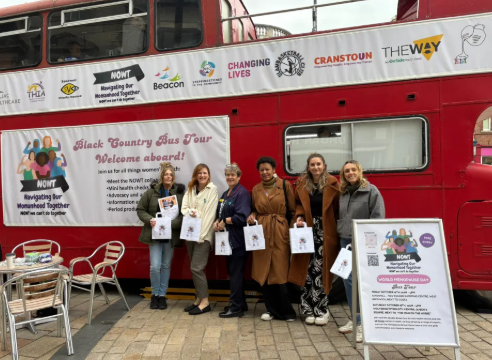
The NOWT women’s health bus tour brought women’s health directly to local communities, welcoming more than 630 visitors on board and engaging hundreds more who were passing by. This took place from 17-18 October, coinciding with World Menopause Day on 18 October.
Across those two days, the team delivered 114 mini health checks, held 169 cancer-related interventions and distributed 1,400 resource bags promoting local services and the NOWT online community. The team also distributed menstrual products, including sustainable and reusable products, to help tackle inequalities in period poverty and accessibility.
Visitors also received education on topics including menopause, contraception, cervical screening, breast and ovarian cancer awareness, and healthy lifestyles, with several referrals made to GPs for raised blood pressure and other concerns.
The tour fostered extensive networking and advocacy amongst its 12 partner organisations, highlighting the power of community-based engagement in tackling stigma and improving access to women’s health support.
In collaboration with The Menopause School, a series of simple and accessible one-page fact sheets have been created based on insights from thousands of women and girls.
Each topic is available in two design styles to suit different learning preferences, and audio-accessible versions are also in development. Topics include:
Period pain
Premenstrual syndrome (PMS)
Heavy bleeding
Perimenopause
Speaking to a GP
Following completion of the bus tour, NOWT members have returned to their local groups to host small community events shaped by local feedback. These events will include partner support, resource bag giveaways and health information.
NOWT have developed a training plan, in collaboration with Periods Matter, for GPs, nurses and other healthcare professionals, based on insights from our listening exercise and co-production workshops. The training combines data and lived experience to:
Highlight challenges in women’s health consultations
Showcase good practice
Offer practical tools for more empathetic and effective care
NOWT is now a recognised member of Wellbeing of Women’s Health Collective. Wellbeing of Women is a charity that works to change the experiences and lives of women, girls and babies through research, campaigns and health information. The Health Collective is led by grassroots organisations that represent women’s voices, with a focus of tackling health inequality for women from marginalised communities.
NOWT is now live and can be followed on Instagram and Facebook. They aim to build a vibrant, inclusive community for advocacy and support, and these platforms will share opportunities, health promotion and updates from the valuable work being done.